Free Your Skilled Team from Low-Value Production Work with outsourced sub-assembly manufacturing
Many manufacturing businesses do not have a sales problem. They have a capacity problem.
Orders are coming in. Customers want faster delivery. New opportunities are available. However, the internal team is already stretched, skilled labour is expensive, and every extra production step adds more pressure.
This is where outsourced sub-assembly manufacturing can make a real difference.
Instead of making every component, bracket, frame, fitting or assembled section in-house, your business can move selected production stages to specialist external suppliers. These suppliers already have the machinery, staff and systems to handle repeat production more efficiently.
As a result, your internal team can focus on the work that creates the most value.
That may include final assembly, installation, customer-specific work, technical service, product development or higher-margin production.
Outsourcing the right sub-assemblies does not mean losing control. Instead, it gives your business more capacity, more flexibility and a clearer route to growth.
The Core Problem: Too Much Internal Time Spent on Lower-Value Work
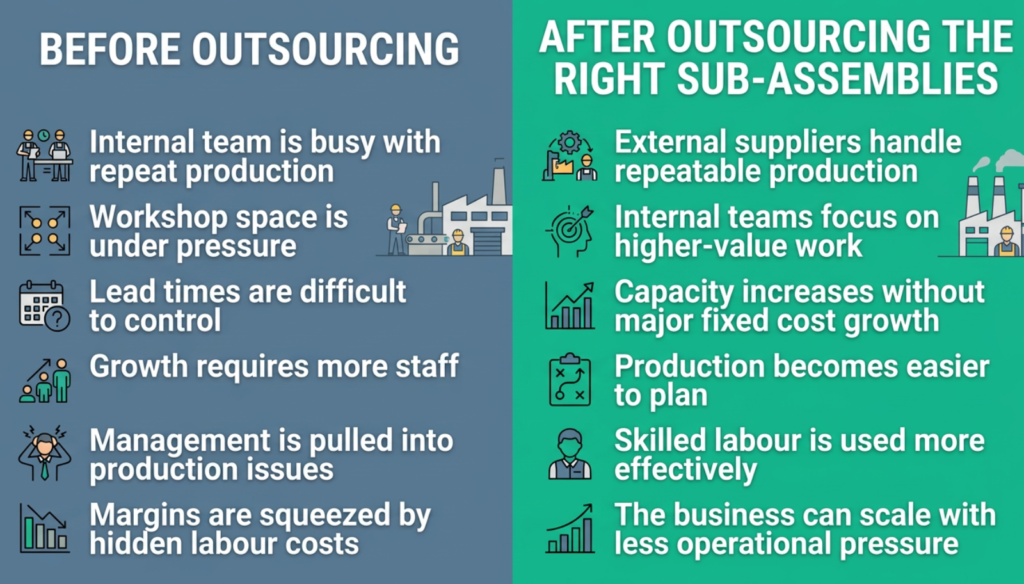
In many businesses, skilled staff spend too much time on repeat production work.
They may be cutting, drilling, welding, folding, preparing surfaces, painting, polishing, fitting parts or carrying out basic assembly. These tasks matter, but they may not be the best use of your people, machinery or factory space.
When your internal team handles every small production stage, bottlenecks start to build. Lead times become harder to control. Overtime increases. In addition, managers often get pulled into daily production problems instead of focusing on growth.
The business may look busy, but that does not always mean it is working efficiently.
A better question is not always:
“Can we make this ourselves?”
The better question may be:
“Should our team be spending time on this?”
A Simple Way to Look at It
Traditional In-House Model
Raw material comes in. Your team fabricates the parts. They finish them, check them, correct any problems and then move them into final production.
This model gives you control. However, it also creates pressure.
Every extra order needs more labour, more supervision, more space and more planning.
Outsourced Sub-Assembly MANUFACURING Model
A specialist supplier manufactures the agreed sub-assembly. They produce it to your specification, apply the required finish and deliver it ready for your next production stage.
Your team then focuses on the work that creates more value.
This approach helps your business increase output without increasing internal workload at the same speed.
What Is Outsourced Sub-Assembly Manufacturing?
Outsourced sub-assembly manufacturing means using an external supplier to produce part of your final product or production process.
For example, this could include a welded steel frame, a stainless steel component, an aluminium section, a painted bracket, a machined part, or a partially assembled product section.
The supplier makes the sub-assembly to your agreed specification. Then your internal team uses it in the final product, installation or customer-specific process.
These sub-assemblies can use many different materials, including steel, stainless steel, aluminium, plastic, rubber, castings, machined parts or mixed materials. They can also include finishes such as powder coating, zinc plating, galvanising, polishing, anodising or painting.
The key point is simple.
You do not outsource the value of your business. You outsource the production stages that consume time, create bottlenecks or stop your team from scaling.
The Real Cost of Doing Everything In-House
Many companies compare external manufacturing with the raw cost of making the part internally.
However, that does not show the full picture.
The real internal cost includes labour, machine time, supervision, quality checks, rework, consumables, space, handling and delays. It also includes the missed opportunity of using skilled staff on repeat work instead of more profitable activity.
Once you include those hidden costs, outsourced sub-assembly manufacturing often becomes much more attractive.
What looks cheaper in-house can become expensive when you measure the full impact on the business.
Cost-Saving Snapshot
Let’s look at a simple example.
A company produces a repeat metal sub-assembly every month. The work includes fabrication, finishing, internal handling and basic pre-assembly.
Current In-House Model
| Cost Area | Monthly Estimate |
|---|---|
| Production labour | £5,000 |
| Supervision and planning | £750 |
| Machine time and consumables | £1,250 |
| Internal handling and storage | £500 |
| Quality checks and rework | £900 |
| Production delays and overtime pressure | £1,000 |
| Estimated monthly internal cost | £9,400 |
The company is not only spending £9,400 per month. It is also using skilled internal capacity that could be focused on higher-margin work.
Outsourced Sub-Assembly Model
| Cost Area | Monthly Estimate |
|---|---|
| External manufactured sub-assemblies | £6,700 |
| Supplier-managed finishing | £850 |
| Incoming inspection and handling | £350 |
| Internal coordination | £250 |
| Estimated monthly outsourced cost | £8,150 |
Potential Saving
| Comparison | Value |
|---|---|
| Current internal model | £9,400 |
| Outsourced model | £8,150 |
| Estimated monthly saving | £1,250 |
| Estimated annual saving | £15,000 |
This example is deliberately conservative.
The biggest gain may not even be the £15,000 annual saving. The bigger commercial impact may come from the extra capacity created inside the business.
If the internal team can now spend more time on final assembly, installation, customer work or higher-value production, the return can be far greater than the direct cost saving alone.
The Capacity Multiplier Effect
Cost saving matters. However, the bigger benefit often comes from extra capacity.
When your team spends too much time on repeat production, they have less time for the work that grows the business. For example, they may struggle to focus on final assembly, customer projects, technical work, product improvement or installation.
Outsourced sub-assembly manufacturing changes that.
A specialist supplier takes over the repeatable production work. As a result, your internal team becomes more available for higher-value activity.
The same team can now support more orders, more projects and more customer-specific work without the business needing to employ more people straight away.
So, instead of asking:
“Can we make this cheaper ourselves?”
It may be better to ask:
“What could our team achieve if this work no longer blocked them?”
That is where outsourced sub-assembly manufacturing becomes more than a cost-saving exercise. It becomes a way to unlock growth.
Scaling Without Increasing Fixed Costs
Growth can create pressure very quickly.
More orders usually mean more labour, more machines, more supervision and more space. Therefore, a business can grow in sales but still struggle to improve profit. Recent Make UK manufacturing outlook reports also highlight the continuing pressure on manufacturers to manage output, recruitment and investment carefully.
This is a common problem.
Outsourced sub-assembly manufacturing gives your business another route. Instead of adding fixed costs every time demand increases, you can use external production capacity.
This gives you more flexibility.
You can increase output without hiring more production staff immediately. You can take on larger projects without overloading your workshop. Also, you can test new product lines without making a major investment in machinery or factory space.
This does not remove the need for strong internal control. However, it does give your business more room to grow before costs rise.
That can make growth safer, smoother and more profitable.
Better Use of Skilled Labour
Skilled staff are valuable. Because of that, your business should use their time carefully.
If your best people spend too much time on repeat fabrication, preparation or basic assembly, they may not have enough time for the work that needs their real skill.
Outsourcing the right sub-assemblies helps solve this.
Your team can focus on the work that needs internal knowledge, customer understanding and technical experience. This may include final assembly, installation, quality approval, engineering improvements or new product development.
In other words, outsourcing does not replace your team.
It protects their time.
A business becomes stronger when skilled people work on skilled tasks. Therefore, moving lower-value repeat work outside can improve both productivity and staff focus.
The Quality Advantage
A good external manufacturing partner should not only reduce cost. They should also improve consistency.
Specialist suppliers often make similar parts every day. Because of this, they may already have the right machines, tools, jigs, fixtures, finishing processes and inspection systems.
That can lead to more repeatable quality.
However, quality does not happen by chance. The process still needs control.
Your business needs clear drawings, agreed materials, confirmed finishes, approved samples and defined quality expectations. In addition, the supplier must have the right capacity and the right attitude to long-term supply.
When you manage this properly, outsourcing can reduce variation, delays and rework.
When you manage it badly, it can create new problems.
That is why supplier selection and technical alignment matter so much.
Where Novex Fits In
Finding a supplier is not difficult.
Finding the right supplier is the real challenge.
The supplier must understand the product, the material, the finish, the quality level and the delivery requirement. They also need the right capacity, communication style and commercial approach.
Novex helps companies build reliable external manufacturing solutions for components, sub-assemblies and finished product sections. A short case study can be found om our website.
With our Supply Focused Methodology, We support the process from supplier identification through to technical clarification, sample control, pricing negotiation, quality alignment, logistics planning and ongoing supply coordination.
As a result, your team does not need to manage every detail alone.
Our role is to reduce the internal burden and help create a supply model that works in the real world. That means moving the right work outside, to the right supplier, under the right terms. This aligns with the wider shift towards more agile manufacturing and supply chain operations, where companies use external capability to improve productivity and resilience.
Is This Right for Your Business?
Outsourced sub-assembly manufacturing is worth considering if your internal team feels busy but your output still feels limited.
It may also be worth exploring if your workshop space is tight, your lead times are under pressure, or your skilled staff spend too much time on repeat production work.
In many cases, the best starting point is not a complete change. Instead, it is better to look at one product group, one repeated component, or one regular production bottleneck.
This gives the business a clear test case.
If the numbers work and the supplier performs well, you can expand the model over time. Therefore, outsourcing can grow in a controlled way rather than becoming a risky overnight change.
The best opportunities are often found in repeatable production stages that matter to the product but do not give your business a strong competitive advantage.
Those are the areas where a specialist supplier may produce more efficiently, while your team focuses on the work that makes your business different.
Conclusion: Stop Letting Production Bottlenecks Limit Growth
Outsourced sub-assembly manufacturing can help your business reduce labour pressure, free internal capacity and protect margins.
It allows specialist suppliers to handle repeat production while your team focuses on higher-value work.
As a result, your business can scale without adding unnecessary fixed costs at every stage of growth.
For many companies, this is not only a way to reduce cost. It is a way to build a more flexible and scalable operation.
If your business is busy but stretched, growing but constrained, or profitable but under pressure, it may be time to look at which sub-assemblies could be manufactured externally.
The right supply model can free your team, reduce hidden costs and give your business the capacity to grow.
Could outsourced sub-assembly manufacturing free capacity in your business?
Speak to Novex about identifying which parts of your production process could be manufactured externally, more efficiently and with less pressure on your internal team.