Yes, the China Plus One strategy is still worth it in 2026 — but the reasons for using it have shifted. It used to be mostly about rising Chinese labour costs. Now it’s about tariff exposure that in some categories exceeds 100%, tightening ESG and carbon-reporting rules on single-origin supply chains, and geopolitical risk that no single-country strategy can absorb. Here’s what’s changed, what hasn’t, and where the real alternatives stand right now.
Last updated: 28 July 2026
What Is the China Plus One Strategy?
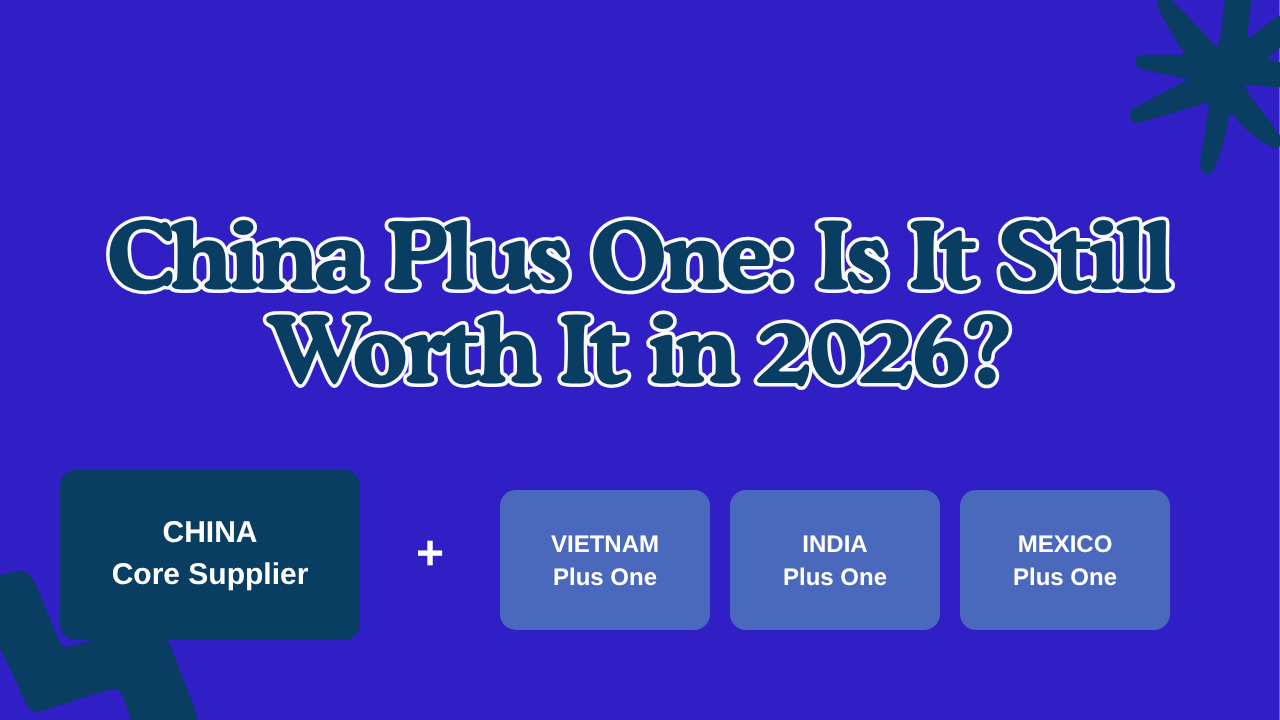
The China Plus One strategy means keeping China as a core part of your supply chain while building genuine secondary production capacity in at least one other country. It isn’t about leaving China — it’s about making sure no single country can take down your entire supply chain if tariffs, policy, or disruption hit that one location.
Is the China Plus One Strategy Still Relevant Given 2026 Tariffs?
If anything, more relevant than ever — though not in the simple way it started. According to DHL’s 2026 supply chain guidance, the sweeping tariffs introduced in 2025 have complicated the strategy without undermining its logic: businesses still need flexibility, even if the specific routes have gotten harder to execute. Section 301 tariffs on Chinese imports remain in force and continue to expand, EU carbon border rules are increasing scrutiny of single-origin supply chains, and Taiwan Strait tensions add a geopolitical risk layer that has nothing to do with cost at all.
What’s changed is the calculation. A China Plus One strategy built purely to chase lower labour costs made sense a decade ago. A China Plus One strategy built for resilience against tariff shocks and geopolitical disruption is a different, more urgent proposition in 2026 — and one that’s much harder to build reactively once a shock has already hit.
What Are the Best “Plus One” Countries Right Now?
| Country | Main Advantage in 2026 | Best Suited To |
|---|---|---|
| Vietnam | Lower labour costs, proximity to Chinese component supply chains | Electronics assembly, textiles, furniture |
| India | Scale, growing electronics manufacturing capability | Larger-volume, longer-term diversification |
| Mexico | USMCA tariff advantage, nearshoring for North American demand | Businesses selling primarily into the US/Canada |
None of these fully replicate China’s scale or specialisation on their own — that’s exactly why “plus one,” not “instead of,” is still the right framing.
What Are the Risks of Diversifying Too Fast?
The biggest risk isn’t staying in China too long — it’s diversifying without proper supplier vetting to hit a deadline. Qualifying a new factory, validating capacity, and aligning quality systems in a new country typically takes a year or more when done properly. Rushing that process to dodge a tariff deadline is how businesses end up trading a tariff problem for a quality problem, which is usually the more expensive one.
Other risks worth planning for: added coordination overhead across more suppliers and regions, unfamiliar regulatory and customs environments, and thinner supplier ecosystems in some plus-one locations compared to China’s depth.
Where Novex Fits In
This is exactly the kind of transition our Supply Focused Methodology is built for — pre-vetting suppliers, validating capacity, and managing the audit and legal work that a rushed diversification skips. Whether that’s run under our standard fee-based sourcing model or scoped as a one-off project, the process is the same: validated suppliers before commitment, not after.
Frequently Asked Questions
What is the China Plus One strategy?
It’s a supply chain diversification approach that keeps China as a core manufacturing base while adding genuine production capacity in at least one other country, reducing the risk of relying on a single location.
Is the China Plus One strategy still worth it in 2026?
Yes. Tariff exposure, ESG/carbon reporting requirements, and geopolitical risk have all increased the case for diversification, even though execution has become more complex than it was a decade ago.
Which countries are the best China Plus One alternatives right now?
Vietnam, India, and Mexico are currently the three leading alternatives, each suited to different priorities — labour cost and component proximity, manufacturing scale, and North American tariff advantage respectively.
How long does it take to set up a China Plus One supply chain?
Properly qualifying a new factory — including capacity validation and quality system alignment — typically takes a year or more. Attempting to compress that timeline is the most common cause of diversification going wrong.
Does China Plus One mean leaving China?
No. The strategy is additive, not a replacement — China typically remains the core supplier, with the “plus one” location providing backup capacity and reducing single-country risk.
Talk to Us About Diversifying Your Supply Chain
If you’re weighing up a China Plus One move and want it done without cutting corners on vetting, get in touch and we’ll walk you through what a properly validated timeline actually looks like for your product category.