The move from prototype to production overseas fails more often at the handoff than at either end. The prototype works. The eventual production run, once things settle down, works too. It’s the middle — design decisions that seemed fine at a single unit but don’t hold at volume, tooling investments made on assumptions that turn out wrong, specifications that drift between the sample and the first real production batch — where most of the real cost and delay actually sits.
Last updated: 3 September 2026.
What Actually Changes Between a Prototype and Production?
More than most first-time exporters expect. A prototype is usually built by hand, or close to it, with a skilled technician quietly correcting small inconsistencies as they go. Production doesn’t have that luxury — the same design has to come out consistently at volume, which means material choices, tolerances, and manufacturing processes that were “close enough” for one unit need to actually hold at scale. This is what design for manufacturability (DFM) review exists to catch, and it matters more than most people assume: as Fractory’s DFM guidance puts it, somewhere around 70-80% of a product’s eventual manufacturing cost is effectively locked in by decisions made at the design stage — long before a factory ever quotes on it.
How Do You Choose the Right Overseas Manufacturer for This Transition?
Not every factory that can build a good prototype can run a reliable production line, and the two capabilities don’t always sit in the same place. A prototyping specialist is often optimised for flexibility and speed on small batches; a production manufacturer is optimised for consistency and cost at volume. Vetting the production partner properly — the same manufacturer vetting checklist that applies to any new supplier relationship — matters just as much here as at any other stage, arguably more, since a poor fit only becomes obvious once you’re committed to tooling.
What’s the Right Order of Steps From Prototype to Production Overseas?
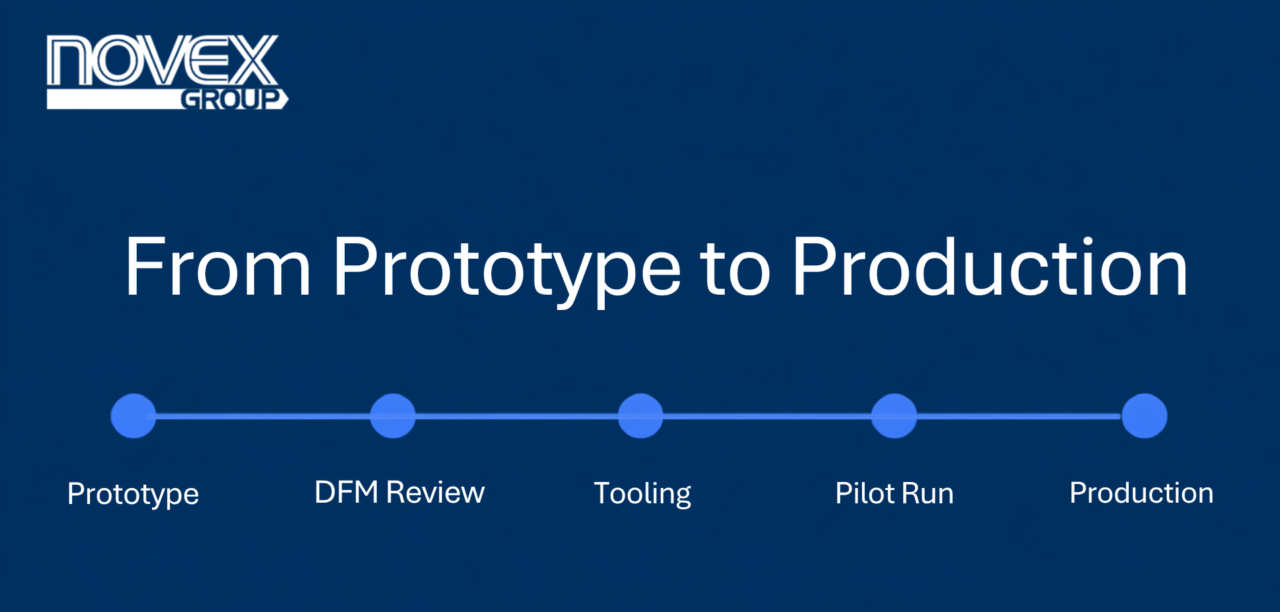
- DFM review before committing to tooling. Revisit the design specifically for manufacturability at volume, not just functionality — this is the cheapest point to catch a problem, and the most expensive point to miss one.
- Tooling investment decision. Understand what tooling actually costs, how long it takes, and what happens if a design change is needed after it’s built, before committing.
- Pilot or pre-production run. A small-batch run using near-final tooling and process, checked against the original specification rather than just visually approved.
- Packaging and compliance sign-off. Confirm packaging, labelling, and any regulatory certification requirements before the first full production run, not after goods have already shipped.
- First production run, monitored closely. Treat the first full-volume run as still provisional — quality checks at this stage catch problems that a smaller pilot run sometimes doesn’t reveal.
Where Does This Fit in Novex’s Process?
This transition sits right at the boundary of our Design Strategy and Acquisition Planning stages — formalising production drawings, tooling scope, and prototype sign-off before moving into supplier auditing and production capacity validation. It’s a natural stage to bring in a sourcing partner if you haven’t already, particularly if this is your first time taking a product to overseas production without in-house experience doing it. Our Supply Focused Methodology manages the full handover, under the same transparent fee-based model as any other engagement.
Frequently Asked Questions
What is the biggest risk in the prototype to production transition?
Design decisions that worked for a single hand-built unit but don’t hold consistently at volume — inconsistent tolerances, materials, or processes that a skilled prototyper quietly corrected but a production line can’t.
Do I need a DFM review if my prototype already works?
Yes. A working prototype confirms the product functions; it doesn’t confirm it can be produced consistently and cost-effectively at volume. DFM review specifically addresses the second question.
Should the prototype manufacturer also handle production?
Not necessarily. Prototyping and production favour different capabilities — flexibility and speed versus consistency and cost at scale — so it’s worth evaluating the production partner separately, even if the prototype supplier is a strong candidate.
How much does tooling typically cost when moving to overseas production?
It varies enormously by product complexity and material, which is exactly why the tooling investment decision should come after a proper DFM review — changing a design after tooling is built is far more expensive than catching the issue beforehand.
What’s the most commonly skipped step in this process?
The pilot or pre-production run. Businesses under time pressure sometimes go straight from prototype to full production, which removes the one checkpoint most likely to catch a volume-specific problem before it’s expensive to fix.
Talk to Us About Taking Your Product Overseas
If you’re moving from prototype to production and want the transition managed properly, get in touch and we’ll walk you through what that looks like for your specific product.