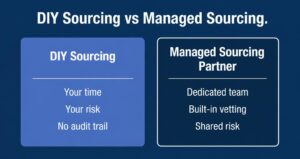
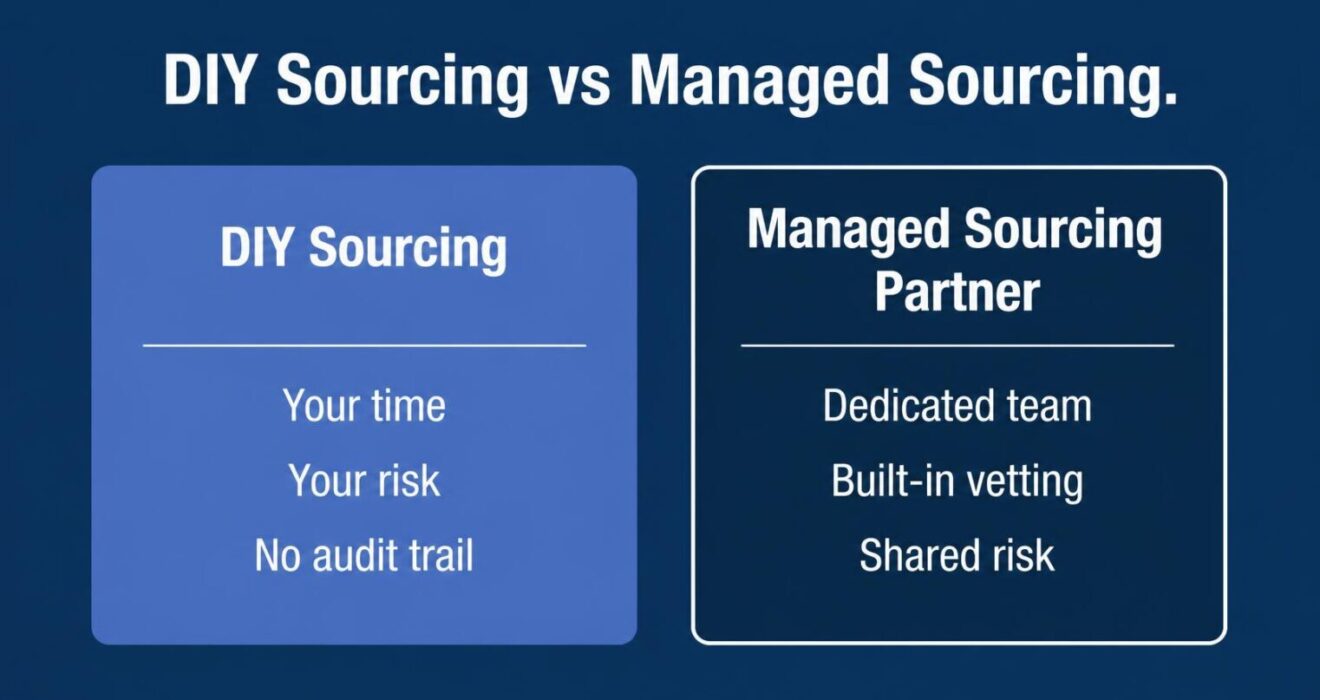
DIY sourcing vs managed sourcing isn’t really a question of which one is cheaper — it’s a question of where the cost shows up. DIY sourcing trades a visible agency fee for a much less visible cost: your own time, the risk of a poorly vetted supplier, and the learning curve of doing factory audits, quality control, and logistics coordination yourself. For a mid-size business, that trade-off often looks very different once it’s actually broken down.
Last updated: 18 August 2026.
What Does DIY Sourcing Actually Cost a Mid-Size Business?
More than the factory quotation, which is usually where the DIY comparison stops. First there’s time: new importers commonly spend a heavy, sustained block of hours in the first few months just learning the process — supplier discovery, sample coordination, negotiation, customs paperwork — hours that would otherwise go into running the business. Then there’s the risk side: poor supplier vetting is a well-documented cause of failed first orders, and a single bad production run can wipe out whatever the DIY approach was meant to save. Add in less obvious costs — currency exposure between agreeing a price and paying it, customs fines, port storage and demurrage fees from unfamiliar logistics steps — and the “cheaper” option frequently isn’t, once it’s measured properly. This is essentially the total cost of ownership principle procurement bodies like ISM apply more broadly: the real comparison in DIY sourcing vs managed sourcing is never just the headline price.
What Does a Managed Sourcing Partner Add That DIY Doesn’t Cover?
Mainly, a team instead of a single point of effort. A managed sourcing partner brings dedicated audit capability rather than a one-off video call, an established supplier network instead of a cold search, and a structured vetting process built from repetition rather than assembled from scratch on your first attempt. That’s the same due-diligence work covered in our guides to vetting a new manufacturer and spotting an unreliable supplier — work that’s genuinely possible to do yourself, but takes real time and experience to do well.
DIY Sourcing vs Managed Sourcing: How Do the Costs and Risks Compare?
| DIY Sourcing | Managed Sourcing Partner | |
|---|---|---|
| Upfront cost | No visible fee | Agreed fee or margin, disclosed upfront |
| Time investment | Significant — falls entirely on you or your team | Largely handled on your behalf |
| Vetting depth | Limited by your own experience and time available | Structured, repeatable audit process |
| Risk exposure | Full exposure to a poorly vetted supplier | Shared, with an audit trail behind it |
| Best suited to | Low-complexity, low-volume, one-off orders | Ongoing supply, higher-risk categories, multi-region sourcing |
Neither column is universally “right” — it depends entirely on volume, complexity, and how much internal expertise already exists in the business.
When Does DIY Sourcing Actually Make Sense?
For a genuinely simple, low-volume, one-off order, especially where you already have a direct relationship with a known supplier, DIY sourcing can be entirely reasonable — the overhead of a managed partner isn’t always worth it for a single small order. It tends to make less sense once volume grows, the product complexity increases, or the business is entering an unfamiliar country or category for the first time, where the learning curve and the risk of a costly mistake both rise sharply.
Where Does Novex Fit In?
This is exactly the calculation our Supply Focused Methodology is designed around — bringing the audit, vetting, and logistics coordination in-house to the engagement rather than leaving a business to build that expertise from scratch. It’s the same distinction covered in our piece on sourcing agent vs sourcing agency, and it’s charged for transparently under our fee-based model — no hidden markup, whichever way the comparison lands for you.
Frequently Asked Questions
Is DIY sourcing actually cheaper than using a sourcing agent?
Not always, once time, risk, and hidden logistics costs are included. DIY sourcing avoids a visible agency fee, but that cost often reappears as time spent learning the process and the financial risk of a poorly vetted supplier.
When should a mid-size business avoid DIY sourcing?
When the order volume is significant, the product is complex, or the business is entering a new country or category for the first time — situations where the learning curve and risk of a costly mistake both increase sharply.
What’s the biggest hidden cost of DIY sourcing?
Time, closely followed by the risk of a failed first production run from inadequate supplier vetting. Both are real costs even though neither shows up on a factory quotation.
Does a managed sourcing partner remove all the risk?
No, but it typically reduces it — a structured, repeatable vetting process catches more than an occasional DIY check would, and spreads accountability rather than leaving all of it with one person doing this for the first time.
Can a business start with DIY sourcing and switch to a managed partner later?
Yes, and it’s a common path — many businesses start with a simple, low-volume DIY order and move to a managed sourcing partner once volume, complexity, or risk exposure grows beyond what they can comfortably manage in-house.
Talk to Us About Your Sourcing Options
If you’re weighing up DIY sourcing vs managed sourcing for your next project, get in touch and we’ll give you an honest read on whether it’s worth bringing in a partner for your specific situation.