The clearest signs of an unreliable supplier are rarely about product quality up front — they’re about how the supplier behaves before you’ve placed an order. Reluctance to allow a factory visit, payment terms that skip the usual deposit structure, and vague answers to specific production questions all tend to show up long before a single defective unit does. None of these is automatically disqualifying on its own. A pattern of them is.
Last updated: 13 August 2026.
What Are the Most Common Signs of an Unreliable Supplier?
Here are the ten worth checking for before you commit to a first order.
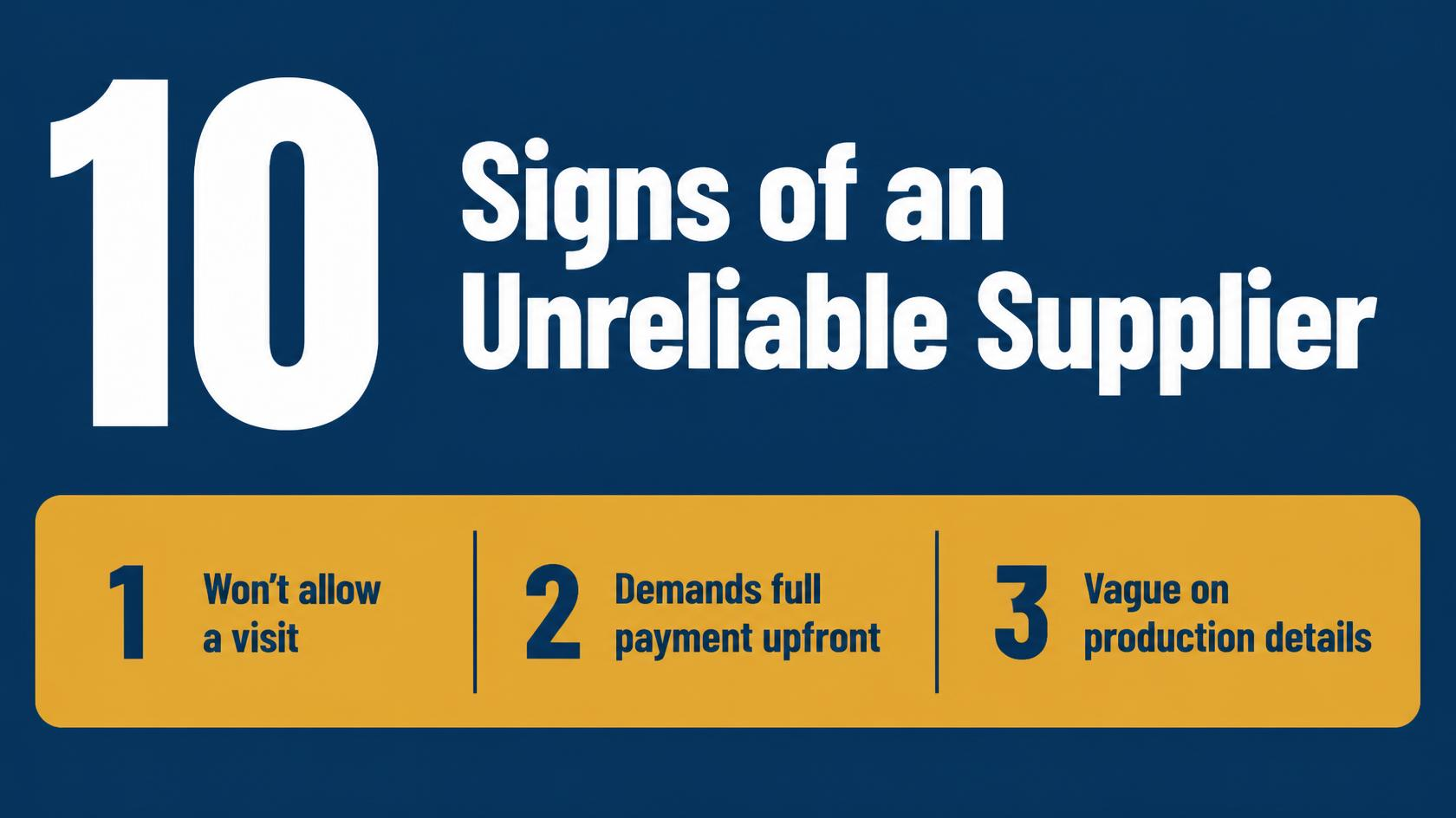
- Reluctance to allow a factory visit or on-site audit. A genuine manufacturer generally welcomes visits without much friction. Repeated postponements, or an offer of only a “showroom” address, is one of the most reliable signs of an unreliable supplier there is.
- Company name mismatches across documents. The name on the business licence, the name on invoices, and the name used in day-to-day communication should all match. Small inconsistencies are sometimes innocent; a pattern of them usually isn’t.
- Communication only through personal messaging apps. A supplier with no professional company email domain, or one who avoids anything except instant messaging, often lacks the infrastructure — or the accountability — of an established business.
- High-pressure sales tactics. Claims of limited production slots, artificial deadlines, or pressure to skip your usual vetting steps are a classic tactic designed to short-circuit due diligence, not a sign of high demand.
- Payment terms that skip the normal deposit structure. Most professional manufacturers work on a split — commonly around 30% deposit, balance on or after inspection — paid into a verifiable company account. A demand for full payment upfront, especially through an untraceable channel, is a serious flag.
- Pricing significantly below the market rate with no clear explanation. A steep, unexplained discount usually means something is being cut — materials, process steps, or compliance — not that you’ve found an unusually good deal.
- Vague or evasive answers to specific production questions. Ask about tooling, capacity, or a specific material spec. A real manufacturer answers directly; a trading company posing as one often deflects or gives generic responses.
- No verifiable references, or a pattern of unresolved complaints. One negative review in isolation is normal for any business. A pattern of similar, unresolved complaints — late shipments, quality disputes, non-delivery — is a much stronger signal.
- Inconsistent quality between samples and bulk production. Samples made by hand under close attention don’t always reflect what a production line delivers at volume. Ask specifically how the supplier controls for this gap.
- A business registered very recently claiming many years of experience. Company registration age is checkable. A mismatch between claimed history and actual registration date is a deliberate red flag, not an oversight.
How Many Red Flags Should You Tolerate?
One isolated flag, on its own, isn’t always disqualifying — a supplier might have a genuinely awkward but explainable reason for one item on this list. What matters is the pattern. Two or three of these showing up together is a strong signal to slow down, and any combination involving payment terms plus reluctance around a factory visit should be treated as close to a hard stop.
What Should You Do If You Spot a Red Flag?
Pause before committing further, and ask for specific evidence rather than reassurance — a business licence, a video walkthrough of the actual production floor, or a reference you can independently contact. If the supplier can’t or won’t provide it, that reluctance is itself part of the answer. It’s the same principle behind the International Trade Administration’s due diligence guidance for businesses evaluating a new foreign partner: verify independently, don’t rely on the supplier’s own account. This is exactly the kind of check that belongs in a proper manufacturer vetting process before the first order, rather than something discovered after a deposit has already been paid.
Where Does This Fit With Vetting a New Manufacturer?
This list is the companion to our full guide on vetting a new manufacturer before your first order — that post covers the structured checklist (licensing, on-site audit, quality systems, references, financial stability); this one covers the specific behaviours that should make you slow that process down. Our Supply Focused Methodology builds both into every engagement, under the same fee-based model as any other project.
Frequently Asked Questions
What is the biggest sign of an unreliable supplier?
Reluctance to allow a factory visit or on-site audit. Genuine manufacturers generally accommodate visits; repeated postponement or an offer of only a sales-office address is one of the most consistent warning signs.
Is it normal for a supplier to ask for full payment upfront?
No. Most professional manufacturers work on a deposit-and-balance structure, commonly around 30% upfront with the remainder due on or after inspection. A demand for full payment upfront, particularly through an untraceable channel, is a red flag.
Can a supplier have one red flag and still be reliable?
Sometimes, yes — a single item can have an innocent explanation. It’s a pattern of multiple red flags, especially around payment terms and factory access, that should actually change your decision.
How do you verify if a factory actually exists?
Request a live video walkthrough of the current production floor, cross-check the address against the registered business licence, and where possible, arrange an in-person or third-party audit before committing to a first order.
Should you still order a sample if you’ve spotted a red flag?
Generally not before resolving the concern. Samples can be produced under conditions that don’t reflect actual bulk production, so a sample alone won’t address concerns about legitimacy, capacity, or payment risk.
Talk to Us Before You Commit to a New Supplier
If something about a potential supplier doesn’t sit right, get in touch before you place the order — we’ll help you work out whether it’s a genuine concern or nothing to worry about.