A reasonable MOQ depends on what you’re buying, not on some universal rule of thumb. A simple printed item might carry an MOQ of a few hundred units. An injection-moulded part often starts at 2,000 or more. The number isn’t arbitrary. It usually traces back to one thing: how much the factory needs to sell to cover its setup costs. Once you understand that, you can actually negotiate it.
Last updated: 8 September 2026.
What Is a Reasonable MOQ?
It varies a lot by product. For simple goods with no custom tooling, a reasonable MOQ often sits in the low hundreds. For injection-moulded or die-cast parts, factories commonly quote 500 to 2,000 units as a starting point. Complex electronics or highly customised items can run higher still. There’s no single benchmark that applies everywhere. The right question isn’t “is this MOQ normal?” It’s “what’s actually driving this specific number?”
Why Do Factories Set an MOQ in the First Place?
Mostly, it comes down to fixed costs. Tooling is the biggest one. A custom mould can cost anywhere from a few thousand dollars to well over ten thousand, depending on complexity. The factory needs to spread that cost across enough units to make the job worthwhile. Raw material minimums matter too. Many materials only come in fixed lot sizes, and a factory doesn’t want leftover stock it can’t use elsewhere. Then there’s changeover time. Every production run needs setup, and a very small run doesn’t cover the labour and machine time that setup takes.
| Product Type | Typical MOQ Range | Main Cost Driver |
|---|---|---|
| Simple printed or textile goods | 100–500 units | Material lot sizes, setup time |
| Injection-moulded plastic parts | 500–2,000 units | Tooling amortisation |
| Die-cast metal components | 1,000–5,000 units | Tooling amortisation, material minimums |
| Complex electronics or assemblies | Varies widely, often 1,000+ | Component sourcing, assembly setup |
How Do You Negotiate a Lower MOQ?
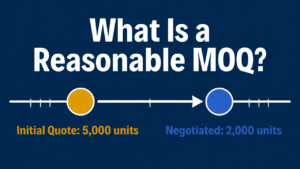
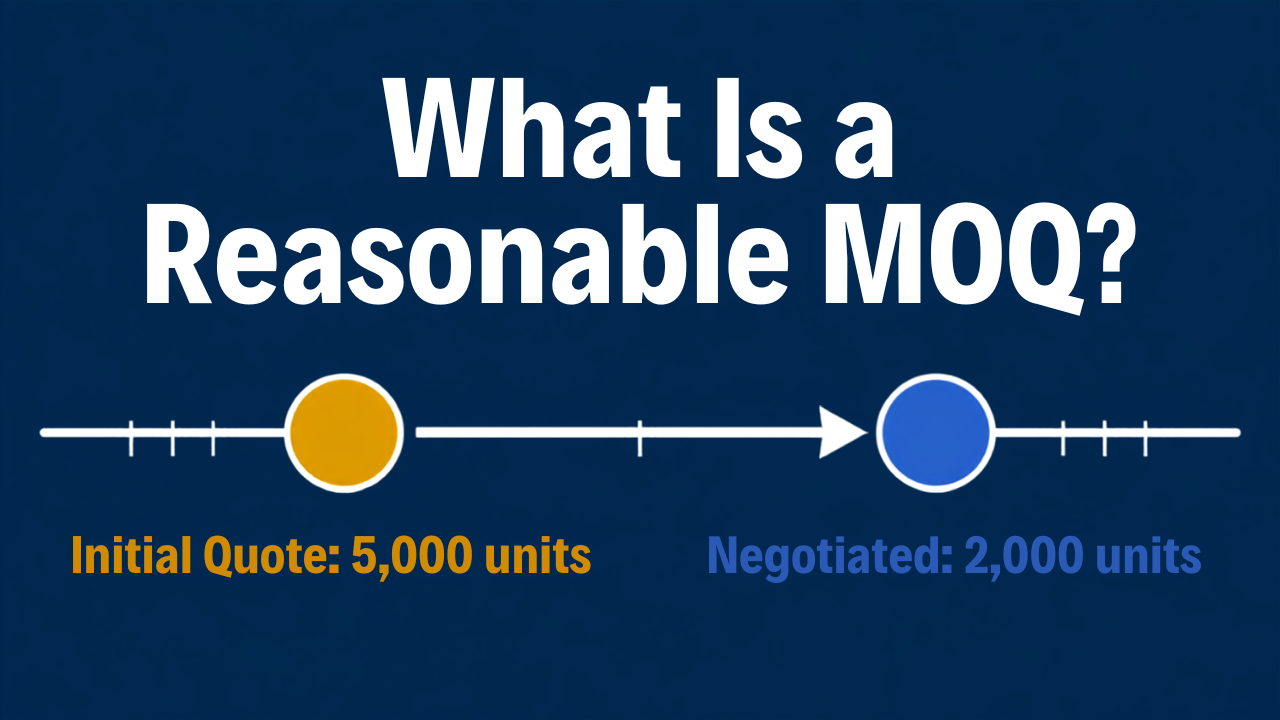
Five tactics tend to work. This follows Shopify’s guide to MOQ negotiation, plus our own experience negotiating directly with factories.
- Ask for a cost breakdown. Get the factory to split the quote into tooling, material, and setup costs. Once you see where the MOQ actually comes from, you can negotiate that specific line item. That beats pushing blindly on the total number.
- Offer a volume commitment over time. Propose a total order across several smaller batches instead of one large one. Many factories will accept a lower per-batch MOQ if the total annual volume still makes the tooling investment worthwhile.
- Pay for tooling separately. If you cover the mould or die cost upfront, the factory no longer needs a high MOQ to recover it. This raises your initial cost but often unlocks a much smaller MOQ on the ongoing order.
- Build the relationship first. Factories often lower the MOQ for a first order when they believe it’ll lead to repeat business. A clear growth plan, shared honestly, can shift the number more than any single negotiating tactic.
- Combine SKUs where possible. Several product variants might share the same base tooling or material. Ordering them together can meet a combined MOQ that no single variant could reach alone.
Where Does Novex Fit In?
MOQ negotiation goes better with an established relationship behind it. That’s especially true if you’re negotiating this yourself for the first time. A repeat sourcing partner brings a track record you won’t have on your own — worth weighing against the DIY sourcing vs managed sourcing trade-off more broadly. Our Supply Focused Methodology includes MOQ negotiation as standard, alongside the same rigorous supplier vetting we apply to every engagement. It’s covered under our usual fee-based model, with no separate charge for the negotiation itself.
Frequently Asked Questions
What counts as a reasonable MOQ for a new product?
It depends entirely on the product. Simple goods might carry an MOQ of a few hundred units. Products needing custom tooling, like injection-moulded parts, often start at 500 to 2,000 units. Ask what’s driving the number before judging whether it’s reasonable.
Can you always negotiate an MOQ down?
Not always, but often. A factory has more flexibility on setup time and material sourcing than on hard tooling costs. Understanding which cost is driving the MOQ tells you how much room actually exists.
Is it worth paying for tooling to lower the MOQ?
Sometimes, yes. Paying for the mould or die upfront removes the main reason the factory needs a high MOQ. This raises your initial cost but can significantly lower the per-order minimum going forward.
Do factories lower MOQs for new customers?
Sometimes, if they believe the relationship will grow. A credible growth plan and a clear ordering cadence often carry more weight than a one-off negotiation on price.
Does combining product variants help meet an MOQ?
Yes, when the variants share tooling or material. Ordering several variants together can meet a combined MOQ that none of them would reach individually.
Talk to Us About Negotiating Your MOQ
If an MOQ is blocking a new product launch, get in touch. We’ll help you work out what’s actually driving the number, and where there’s genuine room to move it.