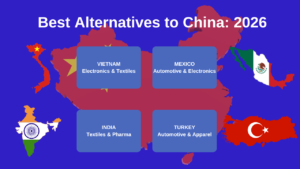
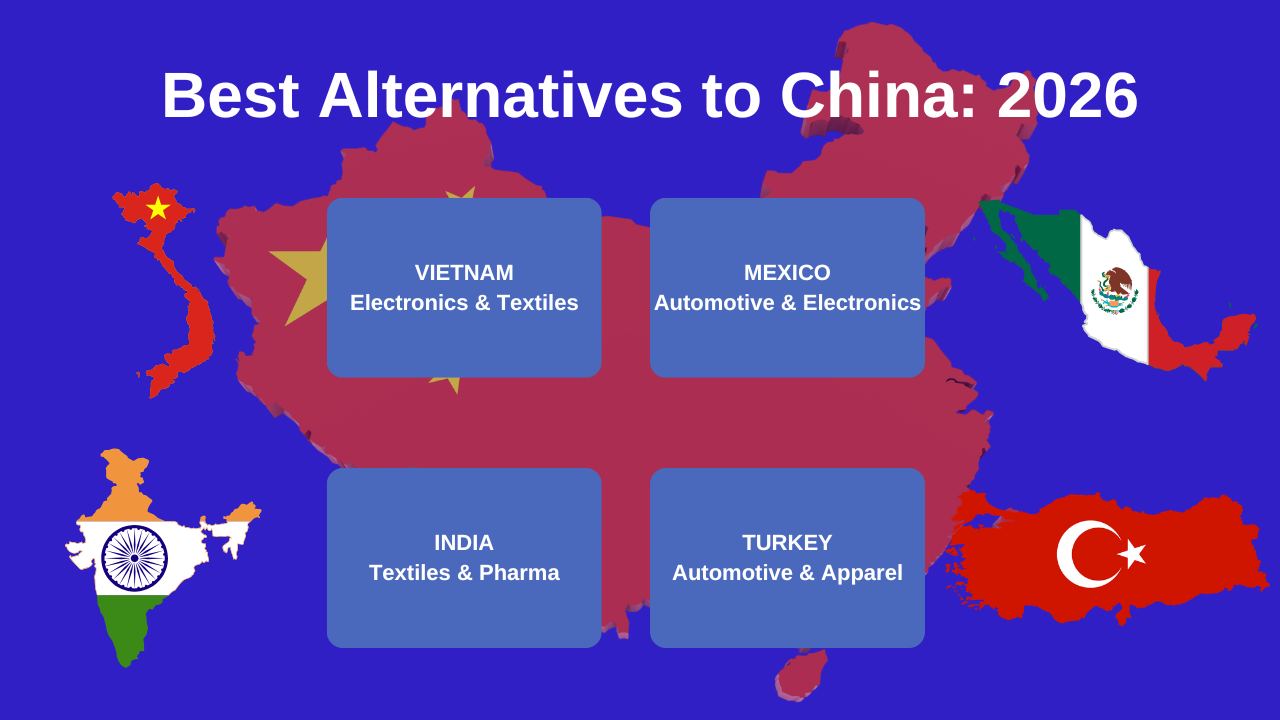
The best manufacturing alternatives to China in 2026 depend entirely on what you’re making. Vietnam and India lead on electronics and textiles, Mexico wins on speed into the US and automotive-adjacent manufacturing, and Turkey and Eastern Europe are pulling ahead for businesses selling into the EU. There’s no single “best” answer — this is a like-for-like breakdown by product category, so you can see where your specific project actually fits.
Last updated: 30 July 2026
Which Countries Are Strongest for Electronics, Textiles, and Hardware?
Electronics: Vietnam remains the workhorse for electronics assembly and is where most volume leaving China lands first, though it’s worth knowing that roughly 80% of its components are still imported and over 90% of tier-1 suppliers are foreign-owned — it’s an assembly hub, not yet a component ecosystem. India is catching up fast on electronics manufacturing capability and scale. Mexico handles mid-volume electronics production well, particularly where speed into the US market matters more than unit cost.
Textiles: Vietnam is strong across footwear, apparel, bags, and luggage. India leads specifically on cotton textiles, hand-finished, and embroidered apparel. For businesses selling into the EU, Turkey and Eastern European manufacturers are increasingly competitive on textiles too.
Hardware and industrial products: Mexico’s strengths in automotive and aerospace extend naturally into hardware and industrial components. Turkey has a well-established base in automotive and white goods (appliances), backed by its EU customs union.
How Do Vietnam, India, and Mexico Compare?
| Vietnam | India | Mexico | |
|---|---|---|---|
| Strongest categories | Electronics assembly, footwear, apparel, furniture | Cotton textiles, embroidered apparel, pharmaceuticals, growing electronics | Automotive, aerospace, mid-volume electronics |
| Main advantage | Low labour cost, proximity to Chinese component supply chains | Scale, lowest raw labour costs, technical workforce | USMCA tariff advantage, speed into the US |
| Main limitation | Still import-dependent for many components | Infrastructure and yield still catching up | Best suited to mid-volume, not the lowest-cost option |
| Best suited to | Businesses already sourcing components from China | Textile and pharma-heavy product ranges | US-focused brands prioritising speed and tariff position |
What About Nearshoring to Europe?
For businesses selling primarily into the EU or UK, the calculation looks different again. According to Harris Sliwoski’s trade law commentary, Turkey, Poland, and other Eastern European countries offer real near-shoring advantages: Turkey’s EU customs union smooths trade in automotive, white goods, and textiles, while Eastern European EU members now supply over 14% of EU27 apparel imports at rates 30–70% below Western European manufacturers. The trade-off is the same one every nearshoring decision comes down to — faster replenishment and lower inventory risk, in exchange for a smaller, less diversified supplier base than Asia offers.
Where Novex Fits In
This is exactly why we don’t default to one region. Our Supply Focused Methodology pre-vets suppliers across the real manufacturing alternatives to China — Vietnam, India, Mexico, and Turkey — so the country you land on is chosen for your product, not for convenience. If you read last week’s piece on the China Plus One strategy, this is the practical follow-up: once you’ve decided to diversify, these are the markets actually worth evaluating, engaged under the same fee-based model as any other project.
Frequently Asked Questions
What are the best manufacturing alternatives to China in 2026?
It depends on the product: Vietnam and India lead on electronics and textiles, Mexico is strongest for automotive and speed into the US, and Turkey/Eastern Europe are the leading options for businesses selling into the EU.
Is Vietnam or India better for manufacturing?
Vietnam is generally stronger for electronics assembly, footwear, and apparel. India leads on cotton textiles, embroidered apparel, and pharmaceuticals, with growing electronics capability. The right choice depends on your product category.
Why would a business choose Mexico over Asia for manufacturing?
Mainly speed and tariff position. Mexico’s USMCA advantage and proximity to the US make it well suited to mid-volume production for US-focused brands, even though it’s rarely the lowest-cost option.
Is nearshoring to Europe a realistic alternative to China?
For EU and UK-focused businesses, yes — particularly for automotive, white goods, and textiles. Turkey and Eastern European manufacturers offer faster replenishment and lower inventory risk, though typically from a smaller supplier base than Asia.
Do these alternatives fully replace China as a manufacturing base?
Not on their own. Each has real limitations — Vietnam’s import dependency, India’s developing infrastructure, Mexico’s mid-volume focus — which is why most businesses run a “plus one” or multi-region strategy rather than a full replacement.
Talk to Us About Diversifying Your Manufacturing Base
If you’re weighing up manufacturing alternatives to China for your next sourcing project, get in touch and we’ll help you match the country to the product, not the other way round.