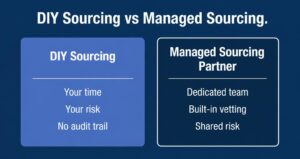

A backup supplier strategy only works if the backup is genuinely ready to step in — not just a name on file that hasn’t produced anything for you in over a year. Dual sourcing sounds simple: use two suppliers instead of one. In practice, most of these plans fail quietly, not because the second supplier was a bad choice, but because it was never kept warm enough to actually activate when needed. Here’s how to build one that works.
Last updated: 25 August 2026.
What Is Dual Sourcing, and Why Do You Need a Backup Supplier Strategy?
Dual sourcing means deliberately splitting production of a component or product across two suppliers instead of relying on one. The point isn’t redundancy for its own sake — it’s making sure that if your primary supplier is hit by a tariff change, a capacity problem, or a quality failure, you’re not starting a new vetting process from zero while your production line sits idle. A backup supplier strategy is what turns that theoretical protection into something that actually functions under pressure.
What Allocation Split Actually Works?
There isn’t one right answer, but there are three common models, each with a different trade-off between cost efficiency and readiness.
| Model | How It Works | Trade-off |
|---|---|---|
| Primary/secondary (80/20 or 70/30) | Most volume goes to the primary supplier; a smaller ongoing share keeps the second supplier active and current | Keeps unit pricing sharp at the main factory while the backup stays genuinely warm |
| Split sourcing (60/40 or closer) | Volume is shared more evenly on an ongoing basis | Highest readiness, but usually the highest cost — neither supplier gets full economies of scale |
| Contingency sourcing | The backup supplier is vetted and qualified but only activated when actually needed | Lowest ongoing cost, but the backup is “cold” — activation takes longer and carries more risk than a warm one |
According to GEP’s analysis of dual sourcing, most businesses that stick with it long-term settle somewhere between an 80/20 and 70/30 split — enough backup volume to keep the second supplier operationally current, without giving up the pricing advantage of concentrating most orders with one factory.
How Do You Keep a Backup Supplier Genuinely Ready?
Three things separate a real backup supplier strategy from a name on a spreadsheet. First, share the plan openly with both suppliers — a backup that doesn’t know it’s your backup won’t prioritise you when it matters. Second, keep technical drawings and specifications genuinely current with both suppliers, not just the primary one; a legacy part that’s changed over time but wasn’t updated with the backup is a failure waiting to happen. Third, and most overlooked: a backup supplier needs the same vetting rigour as your primary one. Our guides to vetting a new manufacturer and spotting an unreliable supplier apply just as much to a backup as to a primary supplier — arguably more, since a backup gets far less day-to-day scrutiny once it’s qualified.
Where Does Novex Fit In?
This is the natural next step from our recent piece on how to reduce supply chain risk as a mid-size manufacturer — a genuine backup supplier is one of the highest-leverage items on that list, and one of the easiest to let go stale. Our Supply Focused Methodology vets and maintains backup suppliers to the same standard as primary ones, under the same transparent, fee-based model.
Frequently Asked Questions
What allocation split should I use for a backup supplier?
Most businesses settle around an 80/20 or 70/30 split between primary and backup — enough ongoing volume to keep the backup operationally current, while keeping most production with the primary supplier for cost efficiency.
Is a backup supplier still useful if it’s never received an order?
Only partially. A qualified-but-cold backup is better than nothing, but it will take longer to activate and carries more risk than one that’s received small, regular orders and stayed current on your specifications.
Does a backup supplier need the same vetting as a primary supplier?
Yes. A backup that hasn’t been through proper due diligence isn’t a genuine backup — it’s an unverified assumption that happens to have a name attached to it.
How much more does dual sourcing cost compared to single sourcing?
It depends on the allocation split. A light 80/20 split has a modest cost impact since most volume still goes to the primary supplier at scale; a more even 60/40 split raises costs further since neither supplier reaches full economies of scale.
When should a business consider building a backup supplier strategy?
Before a disruption, not during one. If a single supplier represents a component with high tariff exposure, long lead times, or no readily available alternative, that’s a strong candidate to build one around now.
Talk to Us About Building Your Backup Supplier Strategy
If a single point of failure is sitting somewhere in your supply chain, get in touch and we’ll help you work out which components actually need a genuine backup supplier strategy, and which don’t.