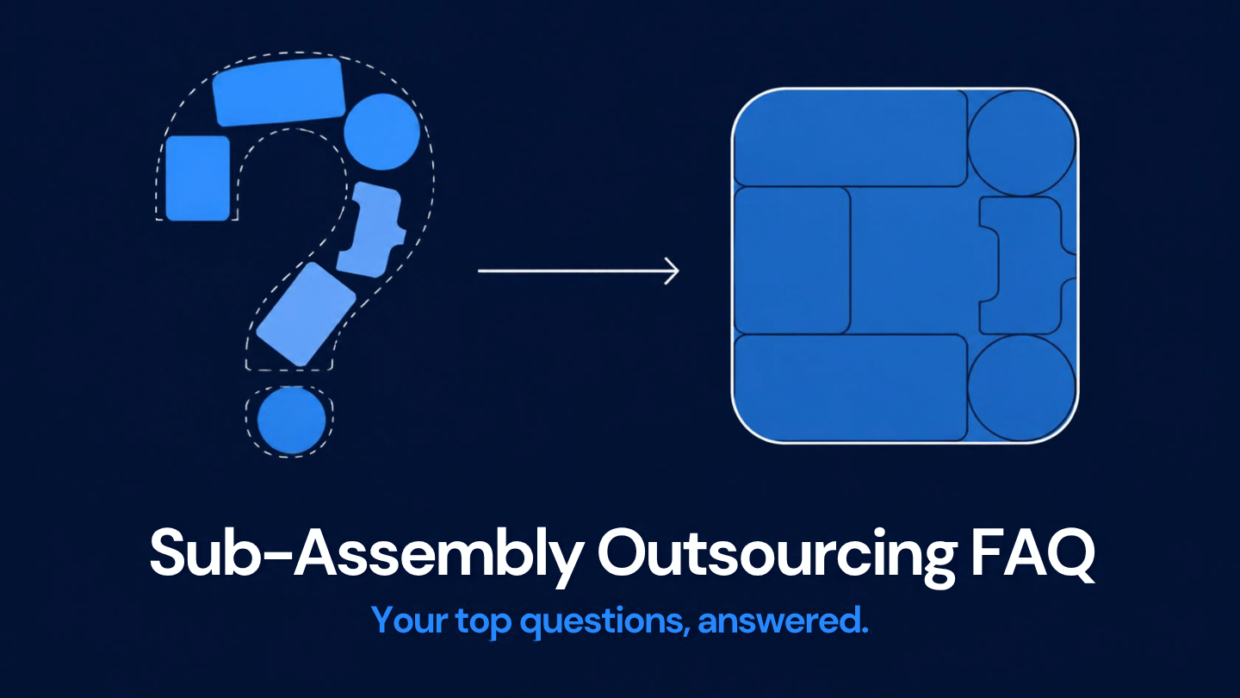
This sub-assembly outsourcing FAQ answers the practical questions that come up once you’ve decided to hand off one stage of assembly — not the whole build — to a specialist partner. For the full breakdown of costs, capacity, and when it makes sense, see our main guide on outsourced sub-assembly manufacturing. Here, we’re answering the specific questions we get asked most.
Last updated: 22 September 2026.
Sub-Assembly Outsourcing FAQ: The Quick Definition
A third-party partner builds a component or module. That module then goes into your final product. You’d otherwise build it in-house. Think of a wiring harness, a bracket-and-fastener kit, or a pre-built electronic module. You still handle final assembly and quality sign-off. The sub-assembly partner handles one specific, repeatable step.
How Is It Different From Full Outsourced Manufacturing?
Scope. Full outsourcing hands over the entire build, start to finish, to a contract manufacturer. Sub-assembly outsourcing is narrower. You keep final assembly, final quality control, and the parts of the process closest to your core product in-house. You only hand off the pieces that don’t need to sit there. It’s a smaller commitment, and usually a smaller risk, than outsourcing the whole thing.
When Does Outsourcing Sub-Assembly Actually Make Sense?
Three signals tend to point the same way. First: your team spends more time kitting components than doing the work that differentiates your product. Second: a specialist partner can build the sub-assembly more consistently or cheaply, particularly at higher burden rates. Third: volume grows past what your floor space and labour can absorb. A full capital investment to scale in-house isn’t justified yet.
Where Does Novex Fit In?
Sub-assembly outsourcing decisions sit right alongside the choices in our prototype-to-production guide. The same DFM and tooling questions apply, just scoped to one component. A sub-assembly partner needs the same rigour as any other supplier. Our manufacturer vetting checklist applies here too, alongside sensible MOQ negotiation for the sub-assembly volumes involved. It’s all covered under our transparent fee-based model and Supply Focused Methodology.
Sub-Assembly Outsourcing FAQ: The Rest of Your Questions
What counts as a sub-assembly, exactly?
Any component or module that combines multiple parts into one unit before final assembly. Wiring harnesses, bracket-and-fastener kits, and pre-built electronic modules are common examples. The defining feature is that it’s one repeatable step, not the whole product.
How much can outsourcing a sub-assembly actually save?
It varies by industry and product. The saving usually comes from lower labour cost per unit and less administrative overhead. Consolidating several component purchase orders into one sub-assembly order also cuts down on paperwork and touchpoints.
Does outsourcing sub-assembly work put your IP at risk?
It can, if you’re not careful. Share only the specifications the sub-assembly partner actually needs to build that one component. Keep the full product design and any proprietary integration details in-house, and use a clear NDA before sharing drawings.
How do you maintain quality control on outsourced sub-assemblies?
Set a clear specification and acceptance criteria before the first order, not after. Run an initial pilot batch and check it properly against spec. From there, periodic sampling on ongoing orders catches drift before it reaches your final assembly line.
How do you choose the right sub-assembly partner?
The same way you’d vet any manufacturer. Verify their legal standing. Run an on-site or video audit of their actual capability. Check references from other clients using a similar process. A partner that regularly handles smaller, more specific runs often fits better than a large-scale full-production factory.
Is sub-assembly outsourcing only worth it at high volume?
Not necessarily. It can make sense at lower volumes too. That’s true if the sub-assembly step needs specialist equipment or skills you don’t have in-house. Volume matters more for whether it’s cost-effective than for whether it’s technically viable.
What’s the biggest mistake businesses make when outsourcing sub-assembly?
Treating the specification as informal or assumed, rather than written down clearly. Ambiguity at this stage causes defects. Those defects show up later, once the sub-assembly is already built into your final product.
This decision follows the same logic behind the University of Cambridge’s Institute for Manufacturing research on make-or-buy decisions. Weigh true total cost, not just unit price. Be honest about which steps are actually core to your product.
Talk to Us About Outsourcing a Sub-Assembly Step
If you’re weighing up whether to outsource a specific sub-assembly, get in touch. We’ll help you work out whether it’s the right call for your product and volume.