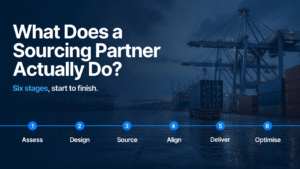
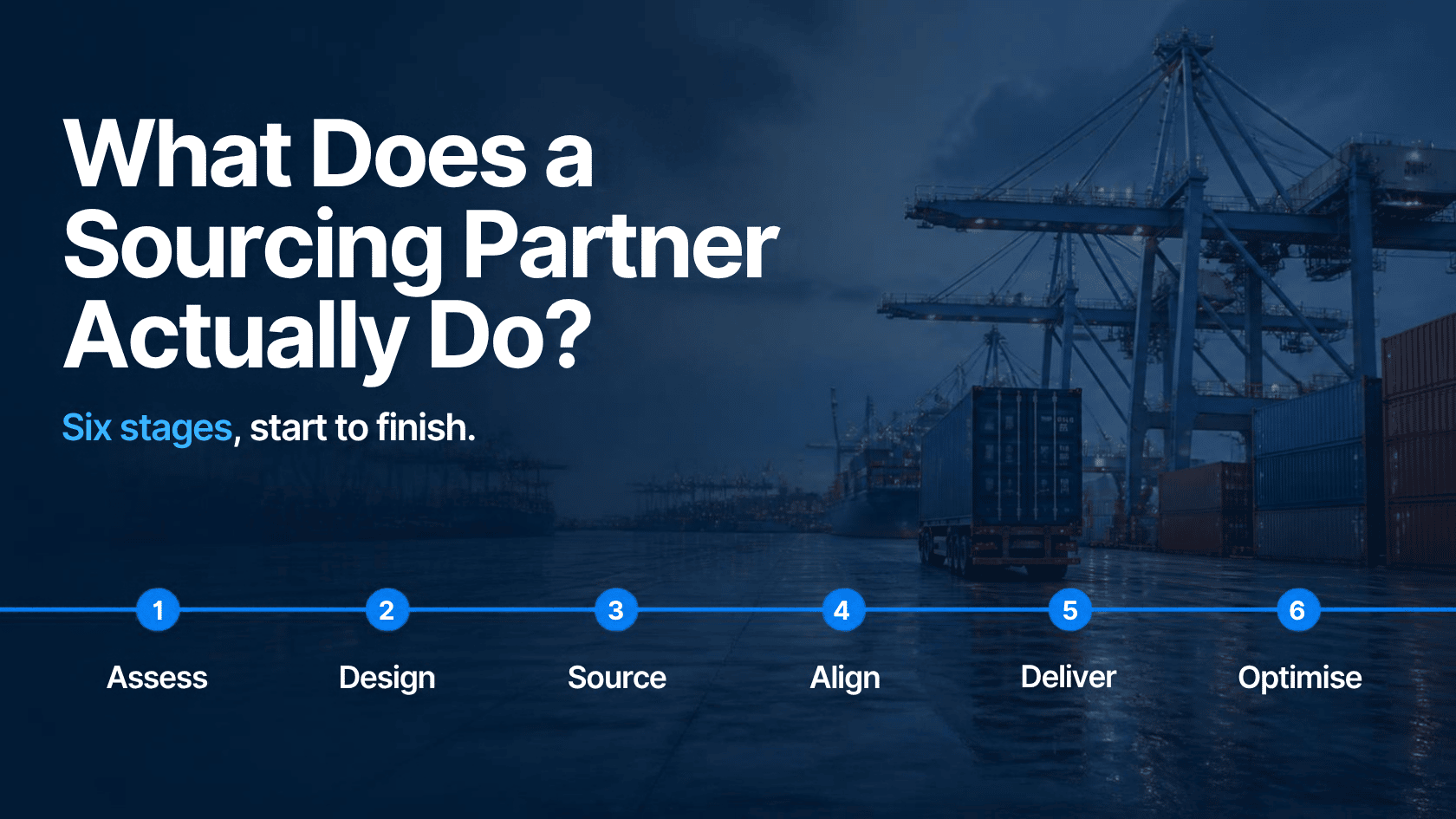
A full-service sourcing partner manages six stages. That’s the short answer to what does a sourcing partner do: assess the opportunity, shape the design, source and qualify suppliers, lock in commercial terms, coordinate delivery, and keep realising value afterwards. It’s not just “finds you a factory.” Done properly, it’s a structured handoff that stops your team getting pulled into tactical vetting and pricing calls.
Last updated: 24 September 2026.
What Does a Sourcing Partner Do, in One Sentence?
Takes a sourcing need from a rough brief to a validated, contracted, running supply relationship. Then stays involved to keep it healthy. This is a growing market. Grand View Research projects procurement-as-a-service will grow from $8.1 billion in 2026 to $16.5 billion by 2033. More mid-sized and large businesses are deciding this isn’t worth building in-house from scratch.
What Happens in the First Two Stages — Assessment and Design?
Stage one is opportunity assessment. A proper sourcing partner clarifies what’s actually needed before contacting a single supplier: technical specs, expected volumes, budget range. They also work out which internal stakeholders need to sign off. Skipping this stage is the biggest reason sourcing projects stall later, once a supplier is already involved and the assumptions turn out wrong.
Stage two is design strategy. It only applies if you’re developing a new product, not resourcing an existing one. This covers concept-to-prototype work, production drawings, and getting the design genuinely ready for manufacturing — not just functional as a one-off sample. Our prototype-to-production guide covers this handoff in more depth.
How Does a Sourcing Partner Actually Find and Qualify Suppliers?
This is stage three, acquisition planning. It’s usually what people picture when they think “sourcing.” The partner identifies the right country and region for the product. They find and audit candidate suppliers. They confirm real delivery capacity at your volume, and run sample procurement before any commitment gets made. Our manufacturer vetting checklist is the detailed version of this stage.
This stage also covers the less glamorous second half: finalising order volumes, tracking certification and testing, and getting packaging signed off. That operational detail is what turns “we found a good supplier” into “we can actually place an order.”
Where Do Commercial Terms and Ongoing Delivery Fit In?
Stage four, value alignment, is where pricing and supply terms get locked in. Final negotiations happen here, followed by contract approval. A proper handover package follows too — technical documentation, certifications, and audit records — so nothing gets lost if the person who ran the project moves on.
Most people overlook stage five: supply coordination. It covers ongoing order fulfilment and quality compliance checks. It also covers full logistics management: freight, insurance, customs clearance, and proof of delivery. You get one point of contact, rather than chasing three different parties every time a shipment moves.
Does a Sourcing Partner’s Job End Once the Supplier Is Set Up?
No — or at least, it shouldn’t. Stage six, value realisation, is the ongoing part. It includes regular compliance and CSR checks, certification renewals, and pricing re-negotiation as volumes grow. Scheduled reviews catch quality drift before it becomes a real problem. A sourcing relationship left unmanaged after the first order tends to quietly degrade. Pricing creeps up. Certifications lapse. Nobody notices until something goes wrong.
Where Does Novex Fit In?
This six-stage structure is our Supply Focused Methodology, not a generic industry framework. It’s the actual process we run for every engagement, scoped to what you need. Stages three through six are always included. Stages one and two apply only when there’s a genuine design or development component. It’s worth comparing this against managing sourcing yourself, and against what a narrower sourcing agent or agency typically covers — “full-service” varies a lot between providers. All of it runs under the same transparent fee-based model, with no markup hidden in the supplier’s price.
Frequently Asked Questions
What does a sourcing partner do that a single sourcing agent doesn’t?
Mainly scope. A single agent often just handles supplier introduction and negotiation. A full-service partner runs the entire six-stage process, including ongoing logistics coordination and supplier performance management, not just the initial match.
Do I need a sourcing partner for every stage, or can I use just part of the process?
We scope most engagements to what’s actually needed. Stages three through six cover sourcing, commercial alignment, delivery, and ongoing value realisation — that’s the core of almost every project. We only add stages one and two, covering deeper opportunity assessment and product design, for genuine development work.
How long does the full six-stage process usually take?
It varies by product complexity and whether design work is part of the project. Proper supplier qualification alone — sampling, auditing, capacity confirmation — realistically takes several months. Compressing this timeline is a common cause of supply problems later.
What happens after the supplier relationship is up and running?
That’s stage six, value realisation. Scheduled compliance checks, certification tracking, and periodic pricing review keep the relationship performing, rather than letting it quietly drift once the initial onboarding excitement wears off.
Is a full-service sourcing partner only worth it for large, complex projects?
Not necessarily. The core value — removing tactical vetting, negotiation, and logistics work from your team — applies at smaller scales too. Engagements are typically scoped and fee’d to match project complexity, not a fixed minimum size.
Talk to Us About What a Sourcing Partner Could Take Off Your Plate
If you’re weighing up what does a sourcing partner do for a business like yours, specifically, get in touch. We’ll walk through which of the six stages your project actually needs.